
Environmental Audit — Vinee Gas Limited LPG Plant
- Client
- Vinee Gas Limited
- Location
- No. 5 Vinee Oil Crescent, Behind Army Barracks, Along Enugu-Onitsha Road, Anambra State
- Sector
- Oil & Gas / LPG
- Service
- Environmental Audit
- Year
- 2025
- Discipline
- Environmental Audit
- Reference
- STV / 1574
Background and Facility Overview
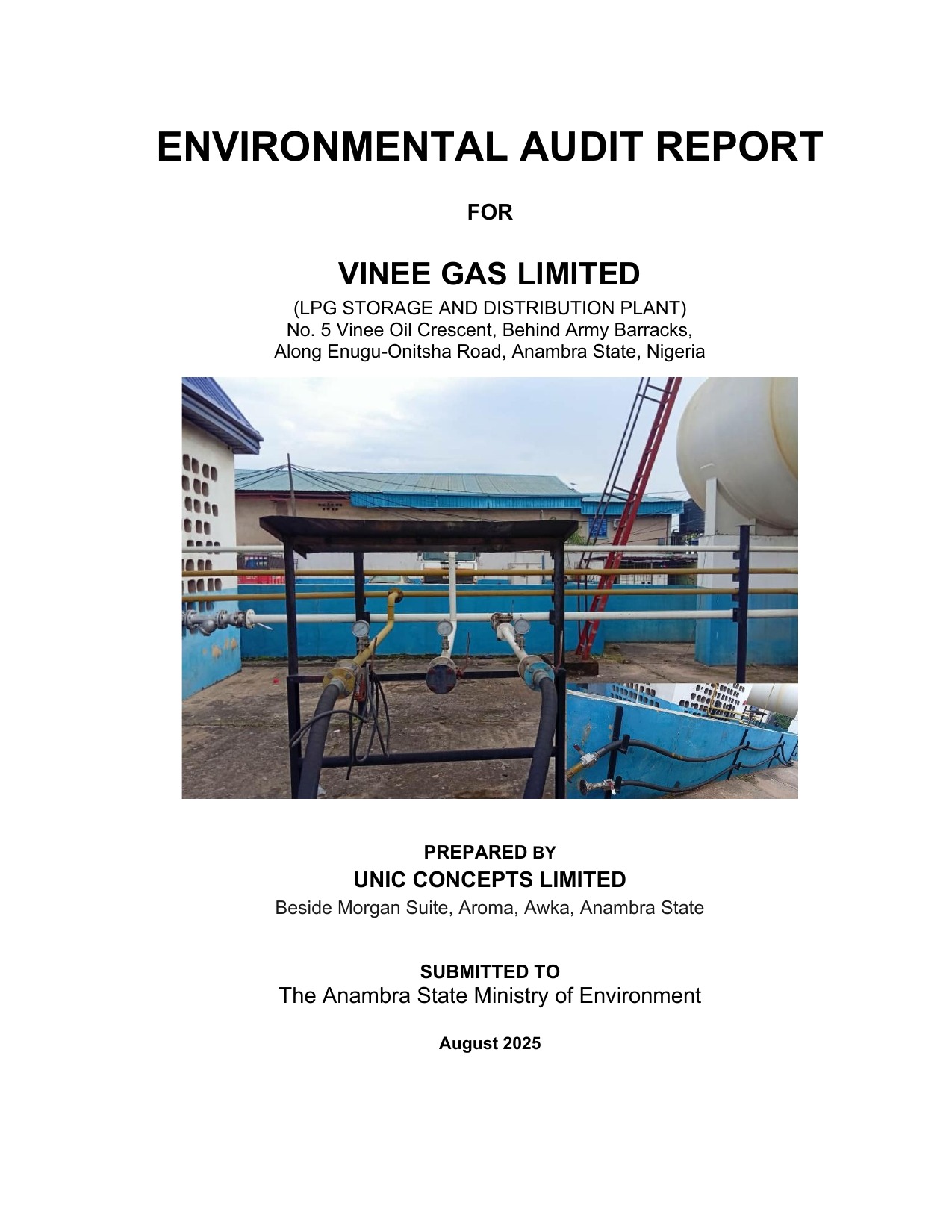
Vinee Gas Limited operates a Liquefied Petroleum Gas (LPG) storage and distribution plant situated at No. 5 Vinee Oil Crescent, Behind Army Barracks, Along Enugu-Onitsha Road, Anambra State, Nigeria. The facility is engaged in the receipt, storage, bottling, and distribution of LPG for domestic and commercial users across the region. The plant features pressurized gas storage tanks, cylinder filling sheds, loading and offloading bays, an administrative block, and auxiliary support structures.
The facility is located at the outskirts of the urban settlement, within a sparsely populated buffer zone that provides appropriate separation from sensitive receptors. The site is accessible via a major road corridor and is surrounded by a mix of light commercial activities and residential developments at a reasonable buffer distance.
Methodology and Scope
This comprehensive environmental audit was conducted in accordance with NESREA National Guidelines for Environmental Audit in Nigeria (2024 Revision) and the Anambra State Environmental Management, Protection and Administration Law, 2024, particularly Part 8 thereof, covering all aspects of the facility’s environmental performance, safety systems, regulatory compliance, and operational practices. The audit methodology included pre-audit documentation review, on-site inspection with photographic documentation, staff interviews, and post-audit analysis and report development.
Key Findings Summary
Positive Findings
1. All major operational permits and environmental documentation reviewed during the audit are current and in order, demonstrating the proponent’s commitment to regulatory compliance. 2. The facility maintains basic safety infrastructure including fire extinguishers, emergency shutdown valves, pressure relief valves, safety signage, and secured perimeter fencing.
3. Air quality measurements at the factory premises and at a 50-metre buffer distance are within NESREA permissible limits for all monitored parameters (NO₂, SO₂, NH₃, and CO). 4. Noise levels at key monitoring locations; entrance, loading bay, and main road are within the NESREA limit of 85 dB(A), confirming satisfactory acoustic conditions. 5. Soil analysis results confirm that the land at the study area is generally within acceptable NESREA limits for the measured parameters, with no evidence of heavy metal or petroleum hydrocarbon contamination at hazardous levels. 6. The facility’s location in a sparsely populated outskirt zone provides a natural buffer, reducing community exposure to operational hazards.
Areas of Concern
7. The facility does not have a formally documented Emergency Response Plan (ERP), representing a significant gap against NESREA and NUPRC requirements. 8. A systematic environmental monitoring programme for ongoing air quality, soil, groundwater, and noise has not been established, limiting the ability to track compliance over time. 9. Waste management procedures are informal as no documented waste management plan or contract with licensed waste disposal operators has been formalised. 10. Staff training coverage, while present at operational level, requires formalisation with documented certification records as required under relevant occupational health and safety standards. 11. Vegetation management in proximity to LPG storage tanks requires closer attention, particularly in the dry season, to eliminate potential fire ignition pathways from dry organic matter.
Environmental Performance Assessment
The facility demonstrates a satisfactory baseline level of environmental performance with generally manageable environmental impacts. Air quality and noise monitoring results confirm that emissions and noise from the facility do not exceed applicable regulatory limits. Soil quality analysis further confirms the absence of significant contamination within the study
area. However, the absence of formal environmental management documentation, an emergency response plan, and a systematic monitoring programme are identified as priority areas requiring immediate attention.
Table I: Compliance Status Summary
Compliance Area Current Status Compliance Priority Actions % Overall Assessment Partially Compliant 80% Immediate corrective actions required NUPRC Technical Standards Partially Compliant 85% Vegetation management; ERP development NESREA Environmental Partially Compliant 82% Monitoring programme; Standards waste procedures Anambra State Environmental Partially Compliant 80% Registration; quarterly Law 2024 monitoring Fire Safety Regulations Compliant with Gap 88% Documented ERP; vegetation clearance Building and Planning Fully Compliant 100% Maintain current status Standards Occupational Health and Partially Compliant 75% Complete staff training Safety certification
Table II: Material Balance and Operational Efficiency
Parameter Estimated Value Industry Status Benchmark Product Recovery Rate >99% >99% Acceptable Fugitive Emissions <1% of throughput <1% Acceptable Waste Generation <0.1% of operations <0.2% Acceptable Water Usage Efficiency Minimal (domestic N/A Efficient only)
Table III: Risk Assessment Summary
Scenario Probability Consequence Current Risk Post-Mitigation Level Risk Dry vegetation → tank fire Medium Catastrophic UNACCEPTABLE LOW (dry season) Equipment failure → gas Low-Medium Medium-High MEDIUM LOW release Vehicle impact on facility Low Medium LOW-MEDIUM VERY LOW
Minor LPG operational Medium Low LOW VERY LOW leak LPG release during Low Medium LOW-MEDIUM VERY LOW delivery
Critical Recommendations
1. Immediate Priority (0–30 Days)
i. Develop and implement a comprehensive, documented Emergency Response Plan (ERP) ii. Clear and maintain all dry vegetation and organic debris from within 5 metres of any LPG storage tank iii. Formalise waste management procedures and engage a licensed waste disposal contractor iv. Register in the Anambra State Ministry of Environment Public Registry (Section 231, Anambra State Environmental Law 2024) 2. High Priority (30–90 Days)
i. Establish a systematic environmental monitoring programme covering air quality, noise, soil, and water ii. Complete and document staff safety and environmental training with proper certification records iii. Enhance fire suppression capacity, including additional fire extinguisher coverage near storage areas
3. Medium Priority (90–180 Days)
➢ Develop a formal Environmental Management Plan (EMP) and operational documentation system ➢ Establish a community engagement and emergency preparedness programme for neighbouring properties ➢ Pursue Environmental Management System (EMS) certification pathways (ISO 14001)