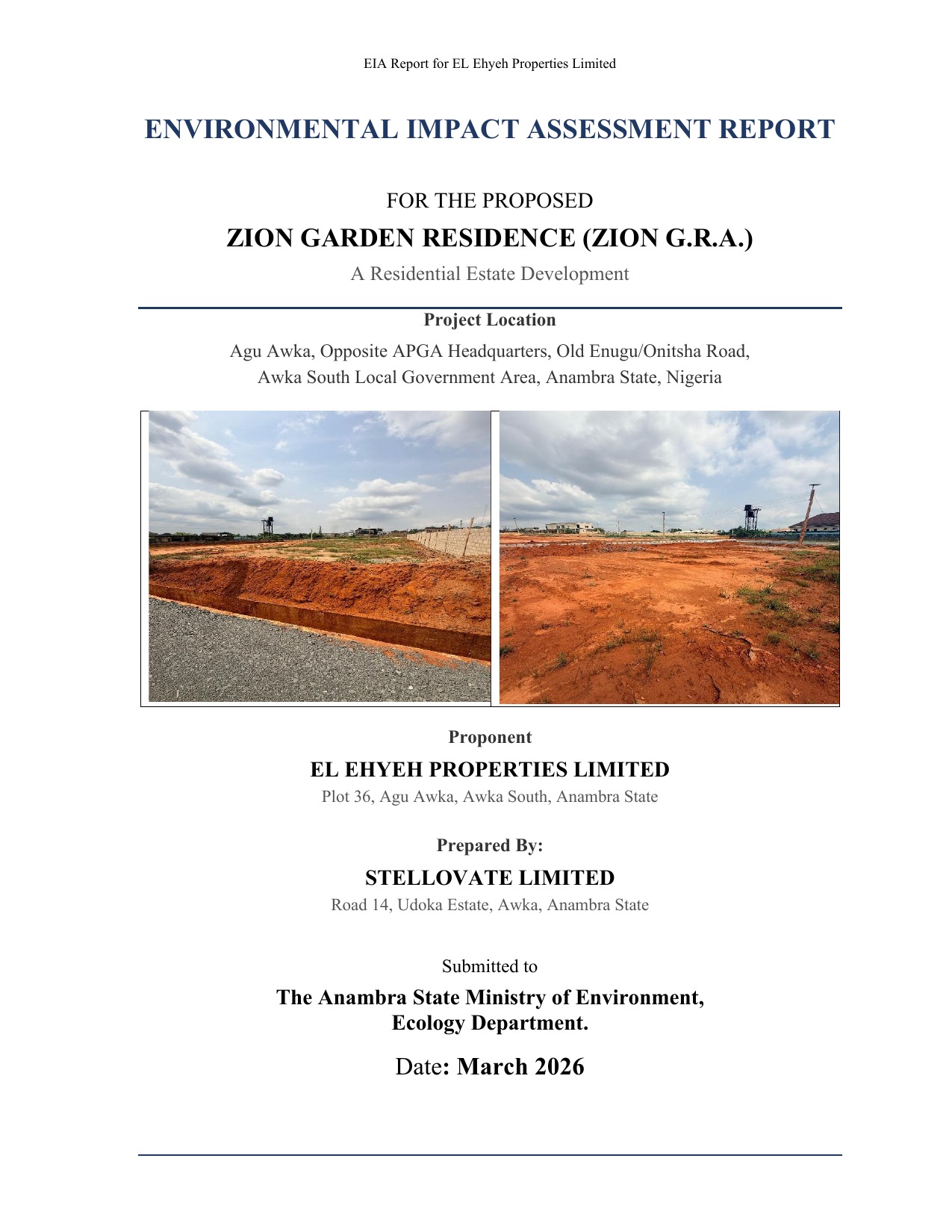
Environmental Impact Assessment — Zion Garden Residence (Zion G.R.A.)
- Client
- EL Ehyeh Properties Limited
- Location
- Plot 36, Agu Awka, Opposite APGA Headquarters, Old Enugu/Onitsha Road, Awka South LGA, Anambra State
- Sector
- Residential Real Estate
- Service
- Environmental Impact Assessment (EIA)
- Duration
- 12–14 months
- Year
- 2026
- Discipline
- Environmental Impact Assessment
- Reference
- STV / 1592
ES.1 Background and Purpose of This Report
Nigeria faces one of the most acute housing deficits in sub-Saharan Africa. In Anambra State, the rapid growth of Awka as the State capital has intensified demand for organised, adequately serviced residential accommodation, driving unplanned settlement expansion and pressure on infrastructure across the city. It is in response to this challenge that EL Ehyeh Properties Limited proposes to develop the Zion Garden Residence a residential plot estate at Plot 36, Agu Awka, along the Old Enugu/Onitsha Road, Awka South Local Government Area, Anambra State.
The proposed estate will provide demarcated and serviced residential plots to individual buyers who will develop their own homes within a structured, secure and well-managed environment. Estate infrastructure to be constructed by the proponent includes a perimeter security fence and manned entrance gatehouse, internal asphalt access roads, concrete-lined surface drainage channels, a centralised borehole water supply system, an EEDC electricity connection with internal reticulation, and landscaped open spaces planted with indigenous trees and vegetation.
Stellovate Limited was commissioned as the EIA Consultant, authorised by both the Anambra State Ministry of Environment to conduct this Environmental Impact Assessment (EIA) and prepare this Report. This Executive Summary provides a concise overview of the full Report's findings.
Table ES-1: Project at a Glance
Project at a Glance Project Name Zion Garden Residence (Zion G.R.A.) Project Type Residential Plot Estate Development EL Ehyeh Properties Limited (RC: 1499498, incorporated 31 May Project Proponent 2018) CEO Ndefo Chinonso Hillary Plot 36, Agu Awka, Old Enugu/Onitsha Road, Awka South LGA, Project Location Anambra State Site Area 11,759.44 m² (approximately 1.18 hectares) Land Tenure Certificate of Occupancy and Deed of Assignment
EIA Category Mandatory Study - EIA Act Cap E12; ANSEMPAL 2024, Schedule 8 EIA Consultant Stellovate Limited Report Reference SV/EIA/AN/026001 Construction Period ~12–14 months from commencement of site mobilisation ~15–21t CO₂e total (construction); ~61–130t CO₂e/a (operation), well GHG Emissions below 25,000 t/a threshold
Legal and Regulatory Framework
The proposed project falls on the federal Mandatory Study List under the Environmental Impact Assessment Act, Cap E12, Laws of the Federation of Nigeria, 2004 (as amended), and on Schedule 8 (the State Mandatory Study List) of the Anambra State Environmental Management, Protection and Administration Law (ANSEMPAL), 2024. Both statutes require that a full EIA be conducted and approved before construction commences. Section 227(4) of the 2024 Law requires the proponent to apply in writing to the Commissioner for Environment, and Section 233 provides that no authority may permit a listed project to proceed until the EIA Committee has acted and all conditions have been fulfilled.
Other applicable instruments include the Environmental Impact Assessment Procedures and Charges Regulations 2021, the National Environmental (Noise Standards and Control) Regulations 2009, the Nigerian Industrial Standard NIS 554:2015 for potable water, and the Factories Act, Cap F1. Specific obligations under the 2024 Law relevant to this project include the duty to landscape all tenement perimeter areas (Section 79), maintain a three-metre setback (Section 80), plant trees annually (Section 82), obtain wastewater clearance for any estate accommodating fifty or more persons before first occupation (Section 216(1)), prohibit waste burning (Section 136) and engage only ASWAMA-licensed waste collectors (Section 152). No construction shall commence until both the federal EIA Certificate and the state EIA Preliminary Report are in hand and all approval conditions complied with.
The EIA Process
The EIA was conducted in the following sequence: registration of the project in the Public Registry of the Anambra State Ministry of Environment; appointment of Stellovate Limited as EIA Consultant; scoping and preparation of Terms of Reference; primary baseline data
collection through field visits in January 2026 (GPS surveying, soil sampling at four points, groundwater quality analysis, ambient air quality measurements at three points and noise environment assessment); systematic impact identification and evaluation using an activity-receptor matrix; stakeholder consultation with regulatory authorities, the ICC Awka management, Agu Awka community leaders and neighbouring property owners; preparation of the Environmental and Social Management Plan (ESMP); and preparation and submission of this Report. A minimum twenty-one-day public comment period will be facilitated by the EIA Committee in accordance with Section 315(1) of the 2024 Law, following which the Committee will issue its Preliminary Report.
The Host Environment
The project site occupies gently undulating terrain within the rapidly urbanising corridor of Awka South Local Government Area, with GPS-confirmed elevations ranging from 49 to 58 metres above mean sea level. The site is located opposite the APGA headquarters on the Old Enugu/Onitsha Road, few meters away from Finotel Classique Hotel, and is situated within the broader vicinity of the International Convention Centre (ICC), Awka which was identified as a high-sensitivity receptor for construction noise and dust and the Rotic Aluminium Extrusion facility.
Soils are predominantly sandy loam to clay loam, of moderate organic content and free of significant heavy metal contamination, but susceptible to erosion if exposed during the wet season. Groundwater quality analysis of the site well revealed exceedances of drinking water standards for total suspended solids (209.5 mg/L against a limit of 30 mg/L), BOD₅ (8.99 mg/L against 3 mg/L) and total coliforms (140 MPN/100 mL), with objectionable odour, taste and turbidity confirming that the site water is not safe for consumption without treatment. Ambient air quality at the site is good, with all measured parameters within WHO and NESREA guideline values. The noise environment is consistent with a mixed residential-commercial setting. No rare, threatened or CITES-listed plant or animal species were identified within the project footprint. The socio-economic environment is characterised by a growing, economically active population with good road and telecommunications infrastructure but without reliable public water supply.
Key Project Activities
The construction phase is estimated at twelve to fourteen months and will be implemented in seven sequential stages: i. Site preparation, mobilisation and installation of pre-construction erosion control measures; ii. Construction of perimeter fence, entrance gate and security gatehouse; iii. Internal road earthworks, sub-grade formation and surface drainage channel construction; iv. Asphalt road surfacing, kerbing and road markings; v. Utility installations - EEDC electricity connection, internal reticulation, borehole drilling, pump installation and water distribution pipework; vi. Landscaping of open spaces and road verges with indigenous trees and vegetation (Sections 79 and 82, 2024 Law); vii. Pre-commissioning water quality testing, system commissioning, snagging and formal handover to the proponent. During the operational phase, individual plot holders will develop their purchased plots over time. The estate management body will maintain shared infrastructure, enforce estate regulations, manage waste and security services, monitor water quality, conduct annual tree planting and submit regular environmental performance reports to ANSEMPAL and the EIA Committee.
Positive Impacts
The project will generate the following significant and lasting positive impacts: i. Provision of organised, secure and serviced residential plots, directly addressing the housing deficit in Awka South and improving living standards for resident families; ii. Temporary employment during construction for an estimated forty to sixty workers, with priority recruitment from Awka South LGA, providing income and skills transfer to the host community; iii. Sustained government revenues through property taxes and development levies, stimulating ancillary commercial and service activity along the Old Enugu/Onitsha Road corridor;
iv. Enhancement of urban green infrastructure through the mandatory planting and maintenance of indigenous trees, providing a long-term carbon sequestration benefit; v. Contribution to the realisation of the overarching objective of the Anambra State Environmental Management, Protection and Administration Law, 2024 to provide a clean, safe and healthy environment for all residents of the State.
Environmental and Social Impacts and Mitigation Measures
The full EIA Report (Chapter Five) identifies and evaluates fourteen significant environmental and social impacts seven during construction and seven during operation. All adverse impacts are temporary or manageable, and none is irreversible. The potential negative impacts and the measures prescribed to prevent or reduce them are summarised in Table ES-2 below.
Table ES-2: Environmental and Social Impacts and Mitigation Measures
Impact Mitigation Measures
Dust and Air ▪ Water bowser spraying of all unpaved areas at least twice daily; continuously Quality during Harmattan (Dec-Feb) (Construction) ▪ All vehicle loads covered with tarpaulins; stockpiles covered when not in use ▪ Dusty operations suspended in high-wind conditions ▪ FFP2 dust masks provided to all workers in dusty tasks ▪ All plant maintained in good working order to minimise exhaust emissions ▪ Legal basis: Section 255(1)(d) and 288, ANSEMPAL Law 2024; NESREA Air Quality Regulations
Noise and Vibration ▪ Construction strictly limited to 07:00-18:00 weekdays; 08:00-14:00 Saturdays; (Construction) no work on Sundays or public holidays ▪ Minimum 72-hour advance written notice to ICC Awka and neighbouring buildings before unusually noisy operations ▪ Temporary acoustic barriers erected at site boundaries adjacent to sensitive receptors ▪ All generators and compressors fitted with functioning silencers ▪ Hearing protection for all workers exposed to ≥85 dB(A) ▪ Legal basis: Section 282, ANSEMPAL Law 2024; NESREA Noise Regulations 2009
Soil Erosion and ▪ Silt traps, earthen berms and geo-textile barriers installed before any ground Sediment Runoff disturbance (Construction) ▪ Phased clearing to limit bare soil area at any one time ▪ Topsoil stripped and stockpiled separately for reuse in landscaping
▪ Prompt re-vegetation of all completed areas ▪ Construction during rainy season (Mar–Jul) managed with heightened care ▪ Legal basis: Part 2 (ANSEWCCA mandate); Sections 136, 137, 145, ANSEMPAL Law 2024
Construction Waste ▪ Waste hierarchy applied: reduce → reuse → recycle → dispose ▪ Segregated storage of soil, masonry, timber and steel offcuts ▪ Open burning of any waste strictly prohibited (Section 136, 2024 Law) ▪ All waste removed by ASWAMA-licensed contractor to approved disposal sites ▪ Workers' sanitary waste managed through chemical portable toilets ▪ Legal basis: Sections 136, 137, 145, 152, ANSEMPAL Law 2024
Traffic Disruption ▪ Material deliveries scheduled outside peak commuting hours (07:00–09:00 and (Construction) 16:30–18:30) ▪ All construction vehicles roadworthy and load-compliant with FRSC standards ▪ Traffic marshal posted at site entrance during busy delivery periods ▪ Road surface in front of site maintained clean and free of mud and debris
Occupational ▪ Mandatory site safety induction for every worker before first day on site Health and Safety ▪ Resident HSE Officer and Site Environmental Officer (SEO) appointed before (Construction) mobilisation ▪ PPE enforced at all times (hard hat, safety boots, hi-vis vest, dust mask) ▪ All excavations deeper than 1.2 m shored or battered to prevent collapse ▪ First aid kit and trained first aider on site at all times ▪ Weekly toolbox talks; quarterly HIV/AIDS and health awareness programme ▪ All incidents reported to SEO within 24 hours ▪ Legal basis: Factories Act Cap F1; ILO OSH Conventions
Wastewater and ▪ Every plot holder required to install a properly designed soak-away pit before Groundwater occupation (Operation) ▪ Minimum 15m separation between any soak-away pit and any water supply borehole ▪ No discharge of raw sewage into estate drainage channels or any watercourse ▪ Biennial inspection of soak-away systems; licensed tanker for desludging only ▪ Wastewater clearance obtained from Wastewater Management Office (Section 216(1), 2024 Law) at least 3 months before first occupation
Domestic Solid ▪ ASWAMA-licensed Private Waste Collector contracted before waste Waste generation commences (Operation) ▪ Minimum twice-weekly collection schedule enforced throughout operation ▪ Colour-coded covered communal bins provided at convenient estate locations
▪ Open burning of waste strictly prohibited; sanitation court referrals for persistent violators ▪ Estate Waste Management Guide issued to all residents
Stormwater and ▪ Internal drainage channels designed for peak storm flow and maintained by Drainage monthly inspection (Operation) ▪ Connection to road drainage network approved by the Clear Drainage Agency (Part 3, 2024 Law) ▪ Drainage capacity reviewed and upgraded as plots are progressively developed ▪ Plot holders prohibited from discharging stormwater onto neighbouring plots
Operational Noise ▪ Generator use prohibited between 23:00 and 06:00; all generators in acoustic (Operation) enclosures ▪ Amplified music and public address systems restricted to 07:00–22:00; require estate management approval ▪ Noise complaints procedure with 5-working-day resolution commitment ▪ Unresolved breaches referred to ANSEMPAL Environmental Protection Unit (Part 11, 2024 Law)
Greenhouse Gas Emissions
Total GHG emissions from the proposed project are estimated at approximately 15-21 tonnes of CO₂ equivalent (CO₂e) for the entire construction period (arising primarily from diesel combustion in construction plant) and approximately 61-130 tonnes CO₂e per annum during operation (from generators, grid electricity, cooking and resident vehicle travel). These figures are more than 190 times below the 25,000 t/a mandatory GHG reporting threshold. The estate's mandatory tree planting programme will provide a carbon sequestration benefit of approximately 6-15t CO₂e per year at maturity. The proponent commits to further minimising the carbon footprint through LED lighting in common areas, promotion of solar photovoltaic adoption, including the installation of a solar panel system to power common-area facilities and security infrastructure within the estate and restriction of generator use.
Stakeholder Consultation
A structured stakeholder consultation programme was conducted in fulfilment of Part 12 of the Anambra State Environmental Management, Protection and Administration Law, 2024 and Section 230(1) thereof. The following stakeholder groups were consulted:
i. Regulatory authorities - ANSEMPAL/EIA Committee, ANSEWCCA, Clear Drainage Agency, ASWAMA and the Wastewater Management Office. Key concerns centred on full compliance with the 2024 Law, particularly the wastewater clearance obligation under Section 216(1) and the requirement for ASWAMA-licensed waste management from the outset of construction; ii. ICC Awka management - expressed concern about construction noise and dust affecting events. Requests for 72-hour advance notice and daytime-only working hours have been fully incorporated into the project's mitigation commitments; iii. Agu Awka community leaders - broadly supportive of the project; concerns regarding dust and noise management, local employment preference and estate drainage design have all been addressed in the ESMP; iv. Neighbouring property owners - concerns about construction-phase nuisance and drainage flood risk are addressed through the ESMP mitigation measures and the project's Grievance Redress Mechanism. Stakeholder engagement will continue throughout construction and operation through the Grievance Redress Mechanism (acknowledgement within 48 hours, resolution within 15 working days), regular communications to the ICC and neighbours, and annual environmental performance reports published by the estate management.
Conclusion and Recommendations
The comprehensive EIA conducted by Stellovate Limited concludes that the proposed Zion Garden Residence project is technically feasible and environmentally and socially acceptable. Its adverse environmental impacts are neither severe nor irreversible, and are fully manageable through the rigorous implementation of the mitigation measures and Environmental and Social Management Plan presented in the full EIA Report. The project's positive contributions to housing provision, employment generation, government revenue and urban development in Awka South are significant and enduring, and substantially outweigh the manageable, largely temporary adverse impacts associated with the construction phase.
To greatly work in harmony with the environment and ensure sustainability, the proponent shall proceed with careful consideration of the prescribed mitigation measures through close follow-up and implementation of the recommended Environmental and Social Management
Plan. The project shall be subject to quarterly performance monitoring during construction and annual monitoring during operation, with reports submitted to ANSEMPAL and the EIA Committee as required by the applicable legislation.
It is the professional recommendation of Stellovate Limited that the proposed Zion Garden Residence project, as promoted by EL Ehyeh Properties Limited, be granted the required approvals by the Anambra State Ministry of Environment so as to implement the project, subject to the full and continuing implementation of all conditions and obligations documented in this Report