Environmental Management Plan — Daisy Garden Farmhouse
- Client
- Mr. Chijioke Francis Ibemesi
- Location
- Dusogu, Awkuzu, Oyi LGA, Anambra State
- Sector
- Agriculture / Livestock
- Service
- Environmental Management Plan (EMP)
- Year
- 2026
- Discipline
- Environmental Management & Compliance
- Reference
- STV / 1586
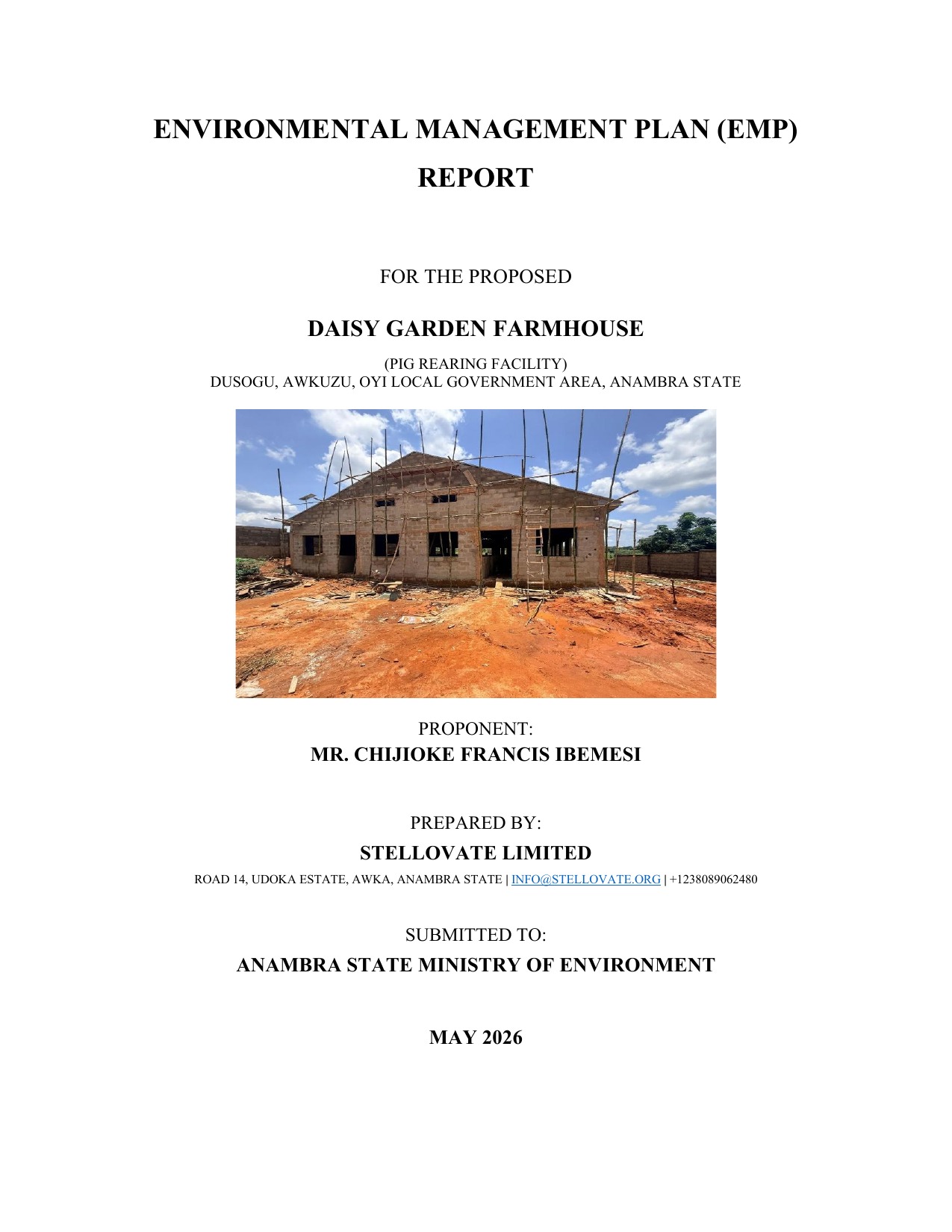
This Environmental Management Plan (EMP) covers Daisy Garden Farmhouse, a pig rearing facility being developed by Mr. Chijioke Francis Ibemesi at Dusogu, Awkuzu, in Oyi Local Government Area of Anambra State, on a plot lying just off the Onitsha-Enugu Expressway, about 1.68 km by road from Igbariam Junction. The site covers approximately 2.5 plots, roughly 1,120 square metres, of which about 246.4 square metres, close to 22 percent, is already built on.
Work on the site has already begun. A pig housing block is under construction, laid out internally with concrete pens and feed troughs under a timber truss roof. A borehole, an overhead water tank on a steel stand, a septic tank, a soak away pit and solar powered perimeter security lighting are already in place, and the compound is fenced with a gate opening onto the untarred access road. Most of the work carried out so far has been done with hand tools rather than heavy machinery, and the generator kept on site is used for pumping water rather than for general construction. This EMP therefore serves two purposes at once: it plans for what remains to be done, and it brings the project's environmental compliance position up to date for work that has already taken place.
The regulatory position for a livestock facility is more involved than for an ordinary residential building. Section 216(1) of the Anambra State Environmental Management, Protection and Administration Law, 2024 names animal husbandry directly among the categories of development that must obtain Wastewater Clearance, and Section 255(1)(f) makes it a specific statutory nuisance to keep any animal in a place or manner prejudicial to health. Under the Federal Environmental Impact Assessment Procedures and Charges Regulations, 2021, a project of this type falls to be screened within Category II, under agricultural and rural development. Registration in the Public Registry of the Ministry, the Wastewater Clearance application, livestock registration with the Ministry of Agriculture, and physical planning approval for the housing block all remain outstanding at the date of this report, and are treated in Chapters 4 and 5 as conditions to be closed out rather than as optional steps.
The site is not isolated. It sits in a corridor along the expressway that is filling in gradually, with a completed two-storey residential building a short distance along the access road and a second compound, still under construction, sharing a boundary fence with the farm near the front gate. The rear and one side of the plot remain open bush and farmland for now, which gives some buffer,
though the pace of building visible along the corridor suggests this should not be relied on indefinitely. These two neighbouring compounds are treated throughout this report as the receptors that matter most directly.
The baseline survey carried out in Mayl 2026 found a clean site. Air quality readings at three stations were comfortably within the applicable FMEnv and WHO reference values, ambient noise at every boundary point measured between 38.6 and 47.5 dBA, well within the 50 to 60 dBA daytime limit, and soil analysis showed no sign of prior contamination on any measured parameter. Groundwater drawn from the on-site borehole met the Nigerian Standard for Drinking Water Quality on every parameter except iron, recorded at 0.38 mg/L against a limit of 0.3 mg/L, a level commonly associated with lateritic terrain across this part of the state and readily managed by aeration and settling. No flora or fauna of conservation concern was recorded, and the site lies outside any Environmentally Sensitive Area listed in the Fifth Schedule to the 2021 Regulations.
That clean baseline reflects the fact that pig rearing has not yet begun on the site, and this report has been written on that understanding rather than treating the current readings as representative of the operating farm. The impacts that matter for this project are the ones that will arise once the pens are stocked: daily manure and wastewater generation, odour reaching the two nearest compounds, fly and rodent populations, the disease risk that comes with keeping livestock, and pressure on a borehole that sits inside the same working compound as the pens. The mitigation plan in Chapter 4 is built around these specifically, and it identifies the manure bay, the perimeter drainage works and the biosecurity measures, the gate foot dip, a quarantine pen and an agreed carcass disposal method, as things that must be completed before pigs are introduced in any number, not afterwards.
A scoping consultation was attempted during the site visit. Notification letters were delivered to both neighbouring premises inviting a representative from each to a meeting on site, and neither household sent anyone on the scheduled date. In place of that meeting, the project team spoke informally with a small number of persons found on site and along the access road during the field visit, mainly construction workers and a caretaker. No objection to the farm was raised in those exchanges, but the engagement was limited and is recorded as such rather than presented as a completed consultation. A fuller, properly recorded consultation with both named households, with adequate written notice and a signed attendance register, is set out in Chapter 5 as a firm
commitment to be carried out before the farm is stocked to any significant capacity, in line with Section 315 of the 2024 Law.
On the basis of the baseline findings, the mitigation and monitoring plan in Chapter 4 and the implementation arrangements in Chapter 5, it is concluded that Daisy Garden Farmhouse, completed and operated in accordance with this EMP, does not present a significant or lasting danger to the environment or to its nearest neighbours, provided the outstanding regulatory approvals are secured, the manure bay and biosecurity measures are in place before stocking, and the fuller consultation described above is actually carried out. This report is submitted to the Anambra State Ministry of Environment in support of the proponent's application for registration and approval, on that basis.