Environmental Audit — Inner House Investment Ltd LPG Plant
- Client
- Inner House Investment Ltd
- Location
- Along Ifite-Unizik Road, Awka South LGA, Anambra State
- Sector
- Oil & Gas / LPG
- Service
- Environmental Audit
- Year
- 2025
- Discipline
- Environmental Audit
- Reference
- STV / 1577
Background and Facility Overview
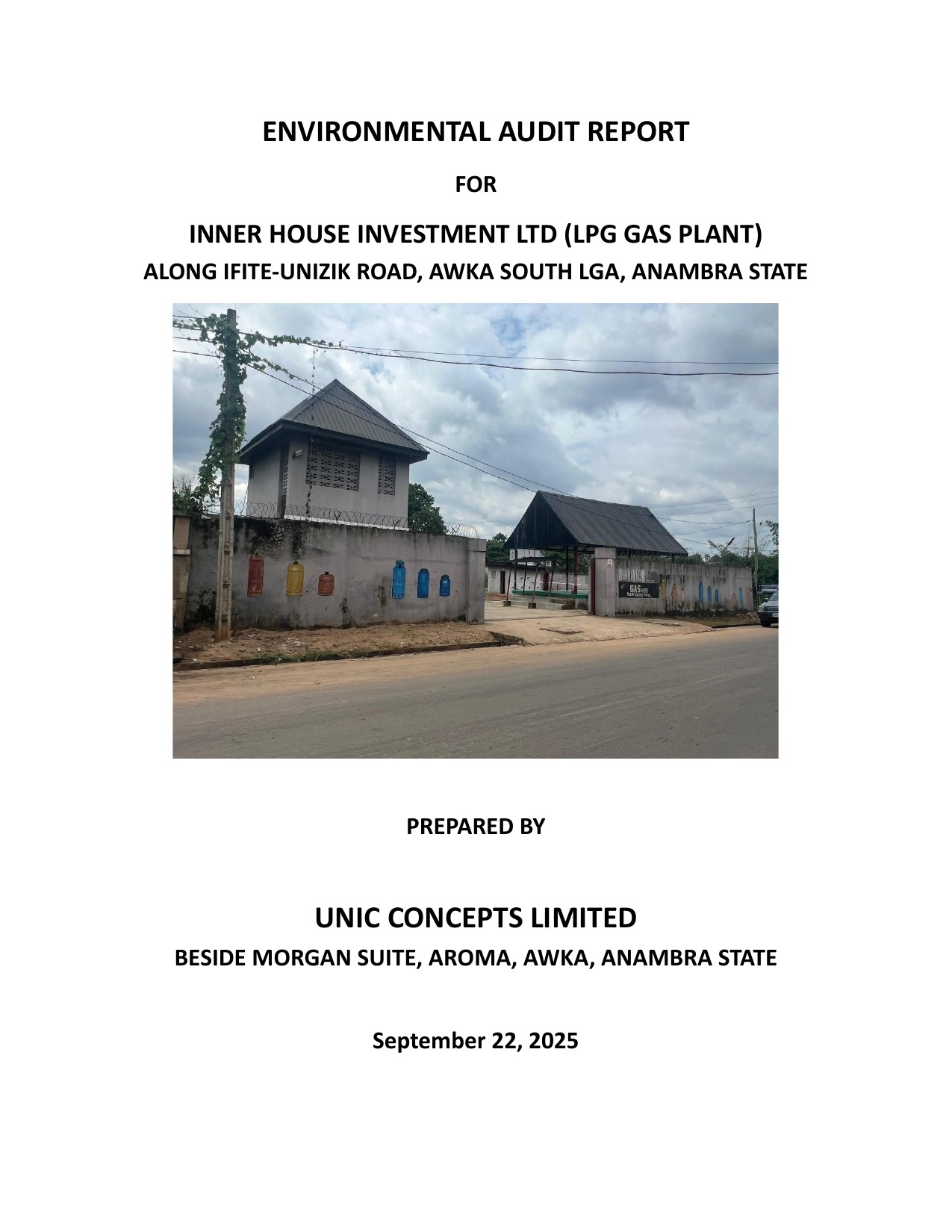
INNER HOUSE Investment LTD operates a retail LPG distribution facility with a storage capacity of 26 tons, strategically located along Ifite-Unizik Road in Awka South Local Government Area, Anambra State. The facility, positioned at coordinates 6.2625139°N, 7.1458657°E at an elevation of 125.52 meters above sea level, has been operational for four years, serving both residential and commercial customers in the greater Awka metropolitan area.
The facility features a single horizontal cylindrical storage tank with professional concrete support structure, a two-nozzle dispensing station under protective canopy, comprehensive safety equipment, and supporting infrastructure including administrative offices, security post, and utility buildings. The site occupies the area of 1189.463 sqm with good road access and appropriate setback distances from neighboring properties.
Methodology and Scope
This comprehensive environmental audit was conducted in accordance with NESREA's National Guidelines for Environmental Audit in Nigeria (2024 Revision), covering all aspects of the facility's environmental performance, safety systems, regulatory compliance, and operational practices. The audit methodology included pre-audit documentation review, extensive on-site inspection with photographic documentation, GPS surveying, staff interviews, and post-audit analysis.
The scope encompassed organizational, geographical, functional, and compliance boundaries as defined in Section 1.5 of the NESREA guidelines, with particular focus on air quality management, waste management systems, safety protocols, emergency preparedness, community impact assessment, and regulatory compliance status.
Key Findings Summary
Positive Findings
1. Regulatory Compliance All major permits and licenses are valid and current, including EIA approval, NUPRC operating license, fire safety certificate, building approval, and environmental permits
2. Safety Infrastructure Comprehensive safety equipment properly installed and maintained, including emergency shutdown valves, pressure relief valves, fire extinguishers, safety signage, and emergency exits
3. Professional Installation Storage tank and dispensing equipment installed to professional standards with appropriate concrete supports and safety clearances
4. Operational Safety Record No recorded incidents in the past 12 months, demonstrating effective operational management
5. Staff Training 70% of staff have completed safety and environmental training programs according to the information provided during site interview.
6. Site Security Adequate perimeter fencing and security infrastructure with dedicated security post and personnel.
Areas of Concern
1. Emergency Preparedness Absence of a formal, documented Emergency Response Plan despite having basic emergency equipment 2. Waste Management System Lack of documented waste management procedures and disposal contracts, though waste bins are present on-site 3. Staff Training Gap 30% of staff require completion of mandatory safety and environmental training 4. Environmental Monitoring Absence of systematic environmental monitoring program for air quality, soil, and groundwater 5. Documentation Systems
Incomplete operational records and environmental management documentation 6. Vegetation Management While living vegetation is properly maintained, formal vegetation management schedule needs documentation
Environmental Performance Assessment
The facility demonstrates satisfactory environmental performance with minimal environmental impact due to its elevated location, appropriate siting, and contained operations. The natural drainage provided by the site's elevation (125.52m) and lateritic soil composition reduces risks of surface water contamination and flooding. Air quality impacts are minimal due to proper setback distances and prevailing wind patterns in the area.
The facility's location in a mixed commercial-residential area with adequate buffer distances ensures minimal community impact. However, the absence of baseline environmental monitoring data limits the ability to quantify actual environmental performance metrics.
Table I. Compliance Status Summary
Compliance Area Current Status Compliance % Priority Actions
Partially Immediate corrective actions Overall Assessment 82% Compliant required Partially NUPRC Technical Standards 85% Vegetation management critical Compliant
NESREA Environmental Partially ERP, waste procedures, 85% Standards Compliant monitoring
Compliant with Fire Safety Regulations 90% Address vegetation fire risk Gap
Building and Planning Fully Compliant 100% Maintain current status Standards
Occupational Health and Partially 75% Complete staff training Safety Compliant
The facility's location in a mixed commercial-residential area with adequate buffer distances (40-60 meters to nearest residences) ensures minimal community impact under normal operations. However, the absence of baseline environmental monitoring data limits the ability to quantify actual environmental performance metrics.
Material Balance and Operational Efficiency
Note that detailed quantitative material balance requires operational data from facility management. Based on 26-ton storage capacity and 4 years operational history, estimated performance indicators.
Table II. Material Balance and Operational Efficiency
Parameter Estimated Value Industry Benchmark Status
Product Recovery Rate >99% >99% Acceptable
Fugitive Emissions <1% of throughput <1% Acceptable
Waste Generation <0.1% of operations <0.2% Acceptable
Water Usage Efficiency Minimal (domestic only) N/A Efficient
Recommendation - Facility management must provide actual operational data for next audit cycle to complete quantitative material balance per NESREA Annexure 4 requirements.
Critical Recommendations
1. Immediate Priority (0-2 months) a. Develop and implement comprehensive Emergency Response Plan b. Immediate removal of all vegetations around the storage tank c. Complete outstanding staff training programs d. Establish formal waste management system with documented procedures
2. High Priority (2-6 months) a. Implement environmental monitoring program b. Enhance operational documentation systems c. Conduct quantitative risk assessment